
The Sand Motor

Celebrating 10 Years of Building with Nature | FAIR Data for Collaboration and Impact
As part of a North Sea coastal defence project, the Sand Motor (Zandmotor) was constructed off the coast of the Netherlands in 2011. The final project conference was combined with the proceedings of the Coastal Dynamics Conference in July 2021 to mark 10 years of the Zandmotor.
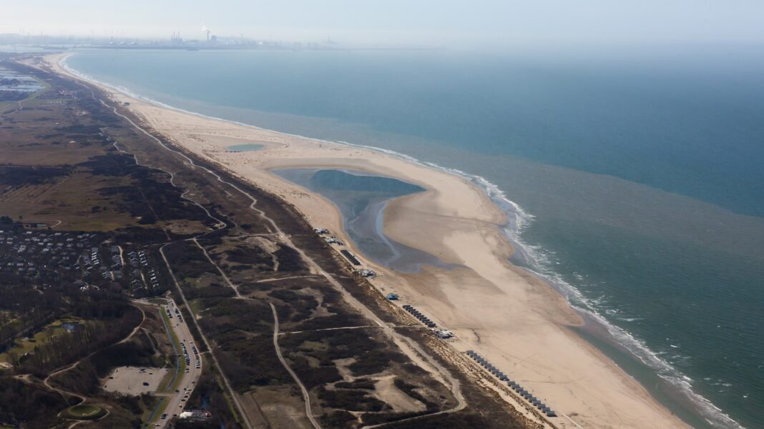
A large peninsula-shaped artificial sandbank covering 128 hectares, the Sand Motor, has served as a living lab along the Dutch coastline for research into the effects of tides, winds and water currents as they spread more than 21 million cubic meters of sand along the coast between the towns of Ter Heide and Kijkduin over the past decade.
Commissioned by Rijkswaterstaat, the Netherland’s Directorate-General for Public Works and Water Management, and the Province of South Holland, the pilot project was initiated with a 2.5 kilometer length of sand that has been distributed over a 5 kilometer stretch of coast over the past decade. A single delivery of a large quantity of sand that was subsequently distributed by natural processes prevented repeated instances of seabed disturbance.
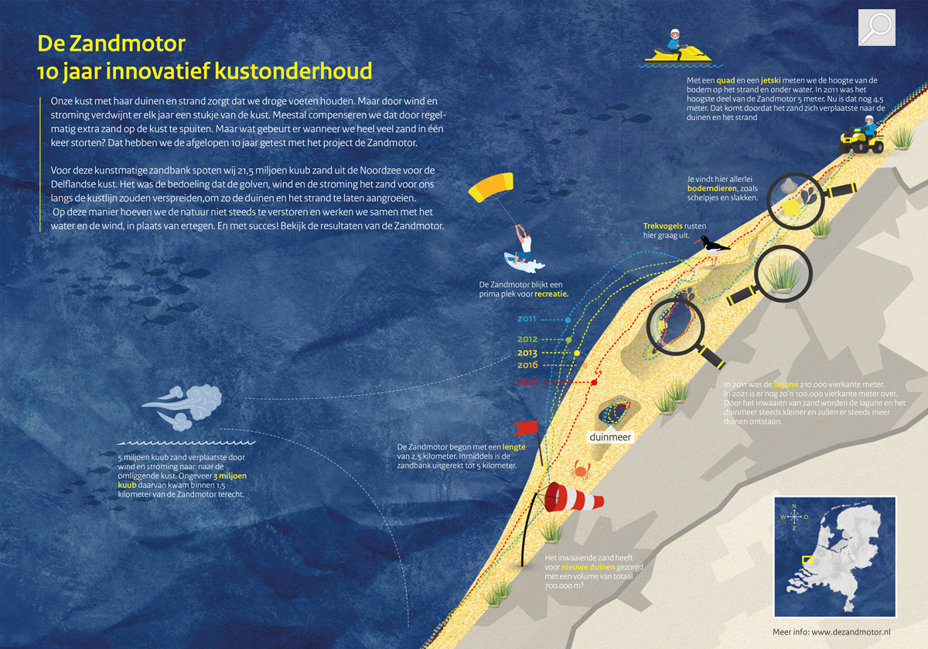
The dynamics of this changing coastal landscape has provided researchers from multiple universities and knowledge institutes from diverse disciplines with the opportunity to observe the real-time effects of tides, wind and water currents.
This innovative coastal maintenance experiment has made it possible to explore a wide range of research questions related to coastline protection and management as well as ecological and recreational expansion efforts.
Research data collected through diverse studies at the Sand Motor is used to address various research questions such as:
- How does the sand spread along the coast and to what extent does the Sand Motor contribute to coastal safety?
- What does the Sand Motor mean for coastal recreation and the development of nature in the shallow sea waters, on the beach and in the dunes?
- Will an increase in fish and birds on the new coastline be observed?
The research data being gathered is revealing insights into how to maintain the coast in an ecologically sound manner in what the Rijkswaterstaat calls “Working with, rather than against, nature”.
“The Sand Motor is an open air museum in our back garden”
Professor of Coastal Engineering, Stefan Aarninkhof, Faculty of Civil Engineering & Geosciences, TU Delft
A remarkable feature of this pilot project is the collaboration across national research institutes, academic universities and public sector agencies. The collaboration is evident not only in the Sand Motor construction and ongoing research agenda, but also in the effort to make research data emerging from the diverse research projects openly available.
Dating back to 2014, several research datasets from research into and about the Sand Motor have been published in our repository. These datasets are from the domains of atmospheric sciences, geology, soil sciences, physical geography and environmental geoscience and the environmental and natural resource evaluation.

The first Zandmotor dataset published in 4TU.ResearchData was submitted by researchers Corjan Nolet and P. Roosjen from Wageningen University & Research. The dataset underlies a research project on modelling spectral reflectance of beach sand under different moisture conditions.
Nolet, formerly of Wageningen University and now with Future Water, notes that the “dataset was later used independently by other researchers from ITC Faculty Geo-Information Science and Earth Observation, University of Twente, underscoring the added value of making data freely available to the research community.”
In 2016, a dedicated Sand Motor collection was established that now comprises 23 different datasets from a diverse range of research projects. Although not an exhaustive collection of all research datasets and software code generated in the course of Zandmotor research projects, this impressive collection represents work, including collaborative projects, of researchers from Aquavision, Boskalis, Deltares, EcoShape, Imares, Nortek, Oregon State University, Provincie Zuid-Holland, Rijkswaterstaat, Shore Monitoring and Research, TU Delft, University of Twente, Utrecht University, Van Oord, VU University Amsterdam and Wageningen University. The collection has received nearly 4,000 views and 915 downloads since September 2020 with a median of 157 views and 35 downloads respectively.
As Annemieke Nijhof, Managing Director of Deltares, noted in her keynote speech Reflecting forward on the Sand Motor at the recent the Coastal Dynamics 2021 conference, “…the Sand Motor gives us a glimpse into the future of the coast of the Netherlands…from a protection point of view as well as in terms of space for nature and recreation. Knowledge generated by research into the Sand Motor offers a starting point for innovative coastal water management where sand is a construction element.”
In the same vein, publishing data arising from this unique project contributes to research into pressing societal and ecological issues of our times through the creation of an openly accessible resource for further use by other researchers.
Written by: Deirdre Casella and Kees den Heijer
Contributors: Marta Teperek, Egbert Gramsbergen, Madeleine de Smaele, Connie Clare
—————————————————————————————————————————
The Sand Motor is a pilot project of Rijkswaterstaat and the Province of South Holland in collaboration with knowledge institutes and universities including among others Deltares, Wageningen Marine Research and TU Delft. For more information www.dezandmotor.nl.
References
- De Zandmotor, accessed 8 July 2021. URL https://dezandmotor.nl/en/
- RWS Animation on Vimeo https://vimeo.com/352255689, available via https://dezandmotor.nl/en/about-the-sand-motor/
- Jeroen Bezem, 5 July 2021, Tien jaar Zandmotor: ‘Extra gereedschap voor het kustbeheer’, Water Forum URL: https://www.waterforum.net/tien-jaar-zandmotor-extra-gereedschap-voor-het-kustbeheer/
- H2O Actueel, 2 July 2021, ‘De Zandmotor is grotendeels een succesverhaal’. https://www.h2owaternetwerk.nl/h2o-actueel/de-zandmotor-is-een-succesverhaal
Dataset DOIs
- Nolet, Corjan; Roosjen, P. (2014): Laboratory spectroscopy experiment: Spectral reflectance of beach sand as function of surface moisture content with sample of beach sand collected from the Sand Motor, the Netherlands. 4TU.ResearchData. Dataset. https://doi.org/10.4121/uuid:866135c2-2be3-4b74-8f9c-922505285a7b
- Zandmotor data / Sand Motor data Collection | Rijkswaterstaat; Provincie Zuid-Holland; EcoShape (2016): Zandmotor data / Sand Motor data. 4TU.ResearchData. Collection. https://doi.org/10.4121/collection:zandmotor