The Power of Sharing Wind Energy Data and Code


“Sharing your data and code requires an initial time investment, but it’s worth it in the long run,” says TU Delft PhD researcher and FAIR data advocate, Mark Schelbergen.

Mark Schelbergen is a final year PhD researcher working at the Faculty of Aerospace Engineering at Delft University of Technology. His research focuses on airborne wind energy which is one of the fastest-growing renewable energy technologies.
Wind energy converters generate electricity from kinetic energy in the wind. The most common concept is the tower-based horizontal axis wind turbine, however, other types of converters exist.
Mark’s interest in wind energy piqued during this Master’s degree when he studied the structural optimization of multi-megawatt offshore vertical axis wind turbine rotors.
Now, Mark’s doctoral studies aim to advance the wind energy sector one step further by developing innovative and cost-effective alternatives to conventional wind turbines.

Kite power
In collaboration with leading start-up and TU Delft spin-off company, Kitepower B.V., Mark investigates energy production characteristics of pumping kite power systems.
“Airborne wind energy systems use flying devices to extract energy from the wind,” says Mark. “The Kitepower system is a large kite attached to a generator on the ground by a cable. The cable unwinds due to the pulling force generated by the kite that’s flying cross-wind.”
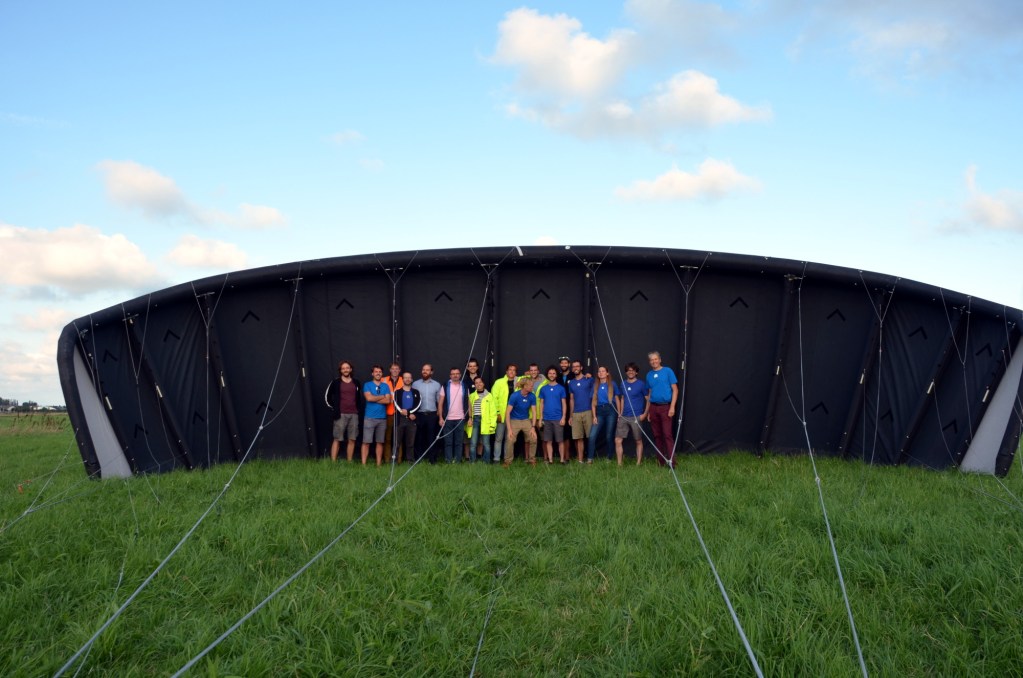
Mark explains the benefits of the pumping kite power system over horizontal axis wind turbines.
“Airborne wind energy systems use up to 90% less material than a conventional wind turbine which significantly reduces the manufacturing costs. Moreover, they’re mobile and easy to deploy at remote locations.”
He adds that airborne wind energy systems offer a lot of flexibility. “Kites can be operated at heights above conventional wind turbines. This enables the harness of stronger and more persistent winds, and potentially increases power output.”

Demonstration of automatic operation of the 20 kW kite power system of TU Delft at the Maasvlakte 2 of Rotterdam Harbour (23 June 2012). Source: Airborne Wind Energy Conference, Book of Abstracts 2015, Schmehl, R. (ed), pg 119. doi:10/bjhs 
Testing the TU Delft 20 kW kite power system at Valkenburg airfield, Leiden, NL (12 April 2012). Source: Airborne Wind Energy Conference, Book of Abstracts 2015, Schmehl, R. (ed), pg. 36. doi: 10/bjhs 
Experimental launch setup of Delft University of Technology (23 August 2012). Source: Airborne Wind Energy Conference, Book of Abstracts 2015, Schmehl, R. (ed), pg 94. doi: 10/bjhs 
Manual launch of a traction kite for power generation (21 August 2013). Source: Airborne Wind Energy Conference, Book of Abstracts 2015, Schmehl, R. (ed), pg 38. doi: 10/bjhs 
Components of the kite power system equipped with 18 kW groundstation and 25 m² LEI V3 tubekite. Source: V. Salma, F. Friedl, R. Schmehl: “Improving Reliability and Safety of Airborne Wind Energy Systems”. Wind Energy, Vol. 23, No. 2, pp. 340–356, 2019. doi: 10.1002/we.2433
Performance estimation
As kite power is relatively new to the wind energy sector, Mark and his colleagues within the Airborne Wind Energy (AWE) research group compare the performance of this novel technology with conventional wind turbines to assess its suitability as a sustainable green energy solution for the future.
To estimate the performance of kite power, their study published in 2019 used historical ERA5 netCDF climate model data created by the European Centre for Medium-Range Weather Forecasts (ECMWF). The dataset includes hourly estimates of wind speed at more than 130 altitude levels over a seven year period (from 2011 to 2017).
In a follow-up study, Mark developed Python software code to analyse the dataset, and produce detailed wind statistics and energy yield estimates of kite power for an on- and off-shore location in the Netherlands.
The software code uses information about kite power flight mechanics, plus information about wind speed and direction over a large height range to estimate the average annual energy yield. It has also been used as part of an AWE Master’s course, demonstrating Mark’s toolchain in education.
Sharing data and code
Mark talks about his research group’s motivations for making the dataset underlying the journal article openly available in 4TU.ResearchData.
“We published a data package that comprises the software code; the original ERA5 data used for the analysis; and, a detailed README file to provide instructions about how to download the ERA5 data and run the scripts.”
“This not only allows future researchers to be able to reproduce our analysis, but they’ll be able to use our data package to produce wind statistics and energy yield estimates for any location in the world. This information is essential for assessing the suitability of deploying kite power systems at specific locations,” he adds.
Motivational mentorship

Mark explains that members of the AWE research group are encouraged to follow Open Science principles by his supervisor, Dr Roland Schmehl.
“Roland is a great mentor and advocate for FAIR data. We have a similar mindset and share the same enthusiasm for making data openly available to accelerate scientific progress and technological innovation, ” says Mark.
“We also appreciate that it can be challenging to find suitable data for wind energy analysis. Plus, it’s not always easy to understand another researcher’s experiments by reading their journal article alone, so having access to the underlying data and code is critical to understanding and interpreting the programme of work correctly,” he adds.
Mark says that all members of the AWE group are mentored to approach research data management in a similar way from the beginning of their project. A prime example is their collective use of GitHub as a version control management tool for collaborative and transparent software code development.
“I have my own GitHub repositories but the group also uses GitHub to share code with one another. This way, we learn good coding and documentation practice from one another,” he says.
Personal development
In order to develop his coding skills, Mark has participated in a Code Refinery workshop where he learnt the value of investing time and effort to make his code robust, readable, reusable and reproducible.
“Sometimes quick fixes are needed, however, these should not be kept for too long in order to produce understandable code that’s useful for others” explains Mark.
He continues, “You have to learn how to write and document your code properly so that you can revisit your scripts years later and understand exactly what you did. It requires an initial time investment, but it’s worth it in the long run when it comes to making code FAIR and reproducible.”
“You have to learn how to write and document your code properly so that you can revisit your scripts years later and execute it without any difficulties. It requires initial time investment, but it’s worth it in the long run!”
Mark’s good practice and open way of working has led to his code being reused and developed by a Master’s degree student at the University of Bonn in Germany as part of a cross-institutional research project.
In addition, at the beginning of the year, he was nominated for an Open Initiatives Trophy award and received a special mention during the Open Science Festival for his inviting attitude toward Open Science and for demonstrating how FAIR data principles can be practically implemented within his research field.
We thank Mark for publishing his dataset in 4TU.ResearchData and sharing his research story. We look forward to following his journey toward more sustainable airborne wind energy solutions.
Written by Connie Clare (4TU.ResearchData)
Edited by Mark Schelbergen and Roland Schmehl (Delft University of Technology)
Cover image snapshot from thekitepower.com