FAIR Data Fund Spring Call 2021: Meet the grantees


Claudiu Forgaci
Assistant Professor in Urban Design at Delft University of Technology @claudiuforgaci
Claudiu is engaged in understanding how spatial urbanisation patterns, at multiple spatial and temporal scales, are related to social-ecological resilience in cities.
With the help of the FAIR Data Fund, Claudiu aims to make the qualitative and quantitative findings of the I‑SURF project, as well as its urban design-driven research methodology, available to the wider community of researchers and practitioners. The data management pipeline will be documented in detail to make sure that the data, workflows and code are FAIR.
Frank Halfwerk
Assistant Professor in Biomechanical Engineering at the University of Twente
Frank is a Technical Physician in cardio-thoracic surgery and the Director of the Cardiac Surgery Innovations Lab. He applied for the FAIR Data Fund with the aim of making this his full scientific career FAIR. Using the fund, he will make all of his data underlying peer-reviewed publications available according to the FAIR principles.
Michelle Kip & Ria Wolkorte
Postdoctoral researchers in Health Technology & Services Research at the University of Twente
@Michelle_Kip, @UTwenteHTSR
Michelle and Ria work in the field of (early) Health Technology Assessment. Their research focuses on evaluating the impacts of healthcare technology in terms of health outcomes, well-being and costs. Through applying citizen science methodology, they aim to increase the role of citizens in the process of healthcare technology development and implementation.
Their dataset concerns rheumatoid arthritis patients’ opinions on research topics, digital environments for citizen science and their desired roles in scientific research. Increasing the level of FAIR for this dataset, and future data collection and publication by TOPFIT Citizenlab is in line with the principles of citizen science.

João Moreira
Assistant Professor in Services and Cyber Security at the University of Twente
João has a background in computer science, particularly software engineering, and his research targets semantic interoperability of ICT solutions for seamless data integration and analytics.
João’s datasets to be refined and published in the 4TU.ResearchData data repository are generated by the Systems Life Cycle Laboratory (SysLCM-Lab). The SysLCM-Lab offers industrial engineering and computer science students an opportunity to remotely perform experiments related to the Smart Industry, Industry 4.0 and Digital Twins during assignments. The current assignment enables students to assemble a ‘hover in a box’.

Thomas Groen
Associate Professor in Natural Resources at the University of Twente
@ta_groen
Thomas studies biodiversity, conservation and remote sensing. With the aim of informing society about the fate of semi-natural ecosystems, Thomas uses empirical spatial interpolation techniques and thermal infrared remote sensing techniques to extract early warning signals of tipping points in ecosystems from satellite time series.
Using the FAIR Data Fund and the help of student assistant, Nivedita Varma Harisena, Thomas will refine data and code underlying his publication, ‘When is variable importance estimation in species distribution modelling affected by spatial correlation?’
Their aim is to create a guidebook that allows future users of Species Distribution Models to be able to change model parameters, visualise the results and reuse the models within their own context.
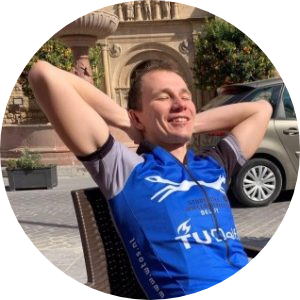
Pavlo Bazilinskyy
Postdoctoral researcher in Cognitive Robotics at Delft University of Technology
@bazilinskyy
Pavlo is the Head of Data Research at SD-Insights and a researcher studying the human factors of automated driving.
He believes that automated driving will save millions of lives. His refined dataset will provide researchers with a better understanding of the interactions between automated vehicles and multiple road users. It contains data from a coupled simulator capable of running immersive simulations with dozens of people, and recording of a real traffic situation from a portable sensor.
More information

The FAIR Data Fund offers researchers a budget (up to €3.500) to cover the costs of making their data Findable, Accessible, Interoperable and Reusable (FAIR data principles). Researchers from TU Delft, TU/Eindhoven and the University of Twente are eligible to apply for the fund.
Applications for the FAIR Data Fund Spring Call are now closed. Subscribe to our newsletter to stay updated about the Autumn Call.
Cover image adapted from Mudassar Iqbal from Pixabay