Spotlight on Infrastructure


As the scientific enterprise becomes increasingly digital, large, and interconnected, the nature of the supporting infrastructure matters more than ever. Upon whom are we dependent as members of the scientific community, and are we comfortable with that dependency? As a sovereign digital infrastructure developer, we at 4TU.ResearchData have some thoughts.
As Mark Huskisson and Johan Rooryck explore in a recent Katina Magazine article, much of our scientific infrastructure is owned and operated by external parties who are not ultimately responsible to the scientific community that uses their products and services. In the same magazine, Kamran Naim explores what the research community should expect from its infrastructure.
Open Access publishing, Open Data, preprints, and post-publication review all require a robust network of digital infrastructures, and it is time that we seriously consider what we need from them. This spotlight sets out three convictions about what a research community should be able to expect from its infrastructure, and how we try to put them into practice.
- Sovereignty
The Open Access movement brought hard lessons on institutional sovereignty and dependence on external partners. The relationship between commercial publishers and the researchers has proven difficult to alter, because we rely on these partners both for access to the existing corpus of scientific knowledge and for the publications on which careers depend.
Despite real progress in making scientific knowledge more accessible, the core problems of ownership and access have not changed much. This is not for lack of trying! But negotiating terms is simply not the same as having open source, institutionally governed, sovereign infrastructure. Research data management is in a similar position. Large, external, sometimes commercially driven services for data curation and preservation are very similar to, and sometimes owned by, the commercial publishers who have dominated the transition to Open Access publishing and come with similar risks.
“No country would completely outsource its military security and defense to commercial control. Nor should science fully entrust scholarly communication to corporations that are vulnerable to fluctuations in article production and takeovers by political and financial actors who are hostile to open science.” (Huskisson & Rooryck, 2026)
Our answer to this problem is to keep the infrastructure and decision-making in the community’s hands. 4TU.ResearchData is governed by four public technical universities in the Netherlands, not by a commercial vendor. We run our own open-source software, Djehuty, developed openly on GitHub, and we are certified through CoreTrustSeal. We have forgone commercial solutions to ensure that we remain fundamentally responsible to and for our researchers and partner institutions.
“The organizations that steward these infrastructures will increasingly shape how knowledge is discovered, interpreted, and reused. That makes questions of governance impossible to separate from questions of openness.” (Naim, 2026)
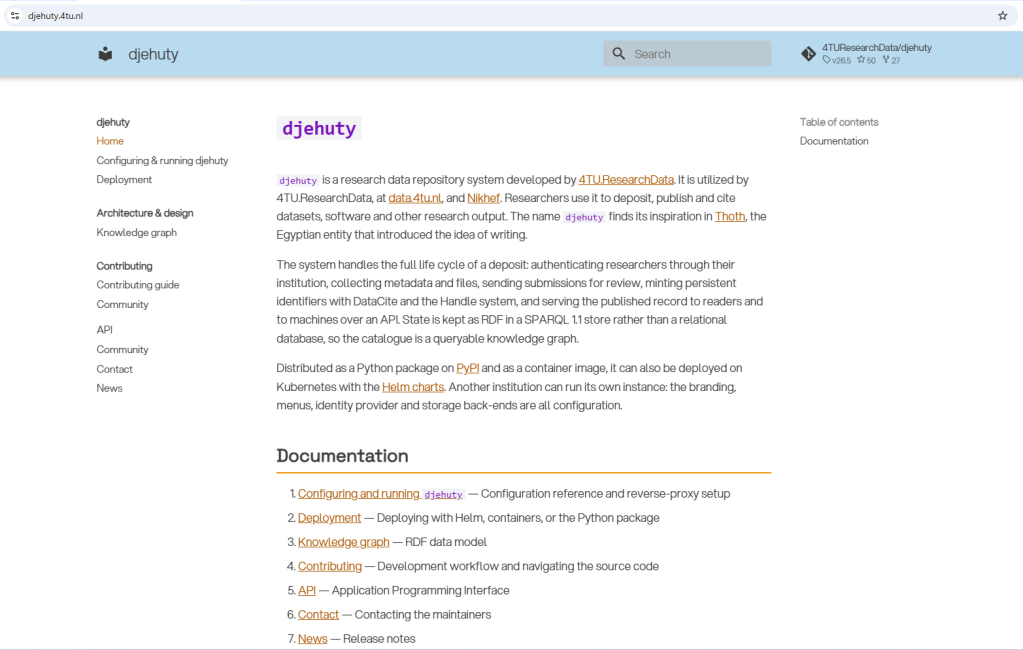
The landing page for Djehuty. We encourage our community to fork it, submit issues, and help build new features.
- Infrastructure as Science
Infrastructure is often treated as a service that is bought from someone else to fulfill an essential but merely technical need. However, how infrastructure works — what it incentivizes, what it requires, who it brings together — directly impacts the day to day work of scientific research. The systems that facilitate, evaluate, and preserve research are an essential part of the scientific enterprise, and they should be the responsibility of, and in service to, the community that depends on them.
In practice, this means our governance directly involves our institutional stakeholders and a good deal of our work happens in personal contact with the people we serve. As our recent Spotlight on Data Curation described, our data curators work alongside researchers to ensure that their deposited research outputs are FAIR and impactful. This keeps our infrastructure shaped by what actually improves the quality of research.
All scholarly infrastructure demands real resources from the research community: library and institutional budgets, but also time, labor, and expertise from researchers and research support staff. It is important to ask what these infrastructures give back to the community in exchange. At 4TU.ResearchData, we aim to be a partner for our community through all stages of the research lifecycle, offering training, support, curation, and a community of peers. We directly reinvest in our community through initiatives such as the FAIR Data Fund, and we aim to remain as transparent as possible about our governance and development.
An example of scientific visualization data with IIIF interoperability hosted on 4TU.ResearchData (Zwarts & Lesueur, 2024).
- Stay Connected
The material realities of research are continually shifting, particularly for research data. Data is growing in volume and complexity, and is increasingly entangled with the code and computational environments needed to make sense of it. Formats, standards, guidelines and best practices are always in flux. Infrastructure cannot be built once and left to run, so developers and providers must be able to recognize and respond to changing needs. Sovereignty gives us the freedom to adapt on our community’s terms, and being embedded in our community means we are close enough to scientific practice to see how it is changing.
Because we develop and maintain our own platform at 4TU.ResearchData, we can respond directly, whether that means introducing OPenDAP servers, supporting scientific visualizations through IIIF, integrating CODECHECK into our core services, or updating our APIs in response to calls from our community to facilitate more bespoke use cases.
We expect this list to keep growing as we continually align with the real needs of our users, and this capacity to continuously evolve is a direct consequence of our sovereign, community-led approach to developing digital infrastructure. If you want to hear more about what this means in practice, especially if you’re one of the many researchers rethinking where your data lives after OSF’s recently announced changes, check out our piece on data repositories.
References
Huskisson, M., & Rooryck, J. (2026). How to Build a Sovereign Global Knowledge Commons. Katina Magazine. https://katinamagazine.org/content/article/open-knowledge/2026/how-to-build-a-sovereign-global-knowledge-commons
Naim, K. (2026, August 26). The Next Chapter of Open Access Is Stewardship. Katina. https://katinamagazine.org/content/article/open-knowledge/2026/next-chapter-for-open-access-stewardship
Zwarts, S., & Lesueur, M. (2024, April 08). Flow through a rock microstructure with ray-tracing: visualisation data. 4TU.ResearchData. https://doi.org/10.4121/0b8b473a-2b37-40f1-aa3a-68d3287091da