FAIR Data Fund use case: The impact-aware robotics database

We interview Maarten Jongeneel (Eindhoven University of Technology) – one of the winners of the FAIR DATA Fund 2023 edition and winner of the Dutch Data Prize 2024. Full team: Maarten Jongeneel, Sander Dingemans, Alessandro Saccon.
What is your project about?
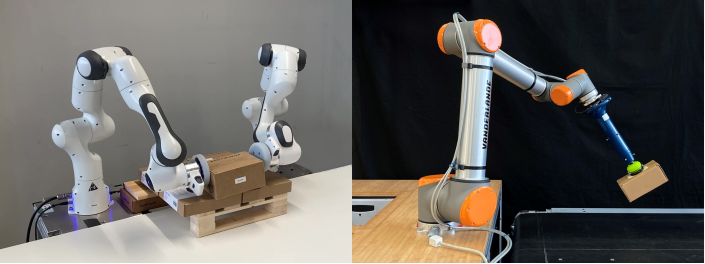
In this project we present a new database supporting the development of impact-aware robotics, an emerging field of research focused on enabling robots to exploit physical impacts with objects and environments to allow for dynamic manipulation and locomotion.
The database can store a wide variety of datasets containing recorded impact experiments where robots, objects, and environments experience intentional collisions while performing dynamic robotic tasks. Examples are object tossing with robotic arms to speed up throughput or grabbing swiftly a heavy object. This open database based on FAIR principles provides access to data that supports research related to, e.g., modeling, control, parameter identification, and object tracking.
Instead of focusing on a single dataset, our project revolves around the creation of a database to share experimental data related to the field of impact-aware robotics. We created a custom web interface where people can search for datasets using various keywords among which those related to the used object, robots, and environments. The datasets itself are single HDF5 files, containing all data and metadata of the experiments. These files are stored on the 4TU.ResearchData servers. More specifically, we use a collection — where the datasets are put together.
This way, any person can upload their datasets to the 4TU servers, and can be added to the database after evaluation. The software tools we provide help in creating and storing data in a FAIR way, following the structure we use for the database. A preprint of the scientific publication related to the database is also available.
What are some key results that you can share?
Storing data in a FAIR way allows for efficient reuse of the data. Within our project, the EU-funded project on Impact-Aware Manipulation (I.AM.), we have collected a vast amount of experimental data with the objective to use this data for learning and validation of models. We observed that data is often stored without considering its reuse. In practice, this often means datasets are lacking a proper structure and addition of metadata for human and machine interpretability. By creating a structure and a taxonomy that can classify the experiments related to our research field, we make the datasets easier to understand, enhancing the possibilities for reuse.
This not only helps other researchers in the field to test and benchmark their methods, but also enhances the quality of any associated scientific publication, as it allows for reproducibility of the results. So far, we have stored over 25 datasets from various institutions including those outside our own project. The interest in the database is growing, and we are currently talking with various institutions to support them in uploading their datasets to the database. At the time of writing, there are six scientific publications using datasets that are stored in the database, showing the added value of our work to the research community.
How has the FAIR DATA Fund helped your work?
Setting up and maintaining a database that is growing in size and interest by various institutions is a demanding job. The FAIR Data fund has helped to create the possibility to maintain and further develop the database. More specifically, it has allowed us to focus on storing additional datasets, both from within the I.AM. project and outside this project, updating the website front-end, and the backend interaction with the 4TU.ResearchData servers. At the same time, the FAIR Data fund has provided us with possibilities to present our work to a wide audience, further increasing the visibility of our work and the benefits of FAIR and open data. Besides focusing on the database itself, we hope to inspire other researchers and stimulate them to take a similar approach for their research field.