Making OperationAIR data FAIR

As nations around the world mark a year since the first lockdown, we rewind to when the Covid-19 pandemic first hit and commend the work of a student team who made a significant impact.
4TU.ResearchData met OperationAIR team members, Tom Dijkhuis and Max Ligtenberg, to celebrate their project success and learn how the Data Refinement Fund 2020 helped them make their AIRone ventilator data findable, accessible, interoperable and reusable.
On 11th March 2020, the World Health Organisation declared coronavirus disease 2019 (Covid-19) a global pandemic. The rapid increase of Covid-19 infections placed a surge of demand on healthcare systems around the world. As hospitals prepared for the first wave of infection there was an expected shortage of ventilators available to care for critically ill patients.
If there was a shortage of ventilators during the Covid-19 pandemic who would get access to one and who wouldn’t?
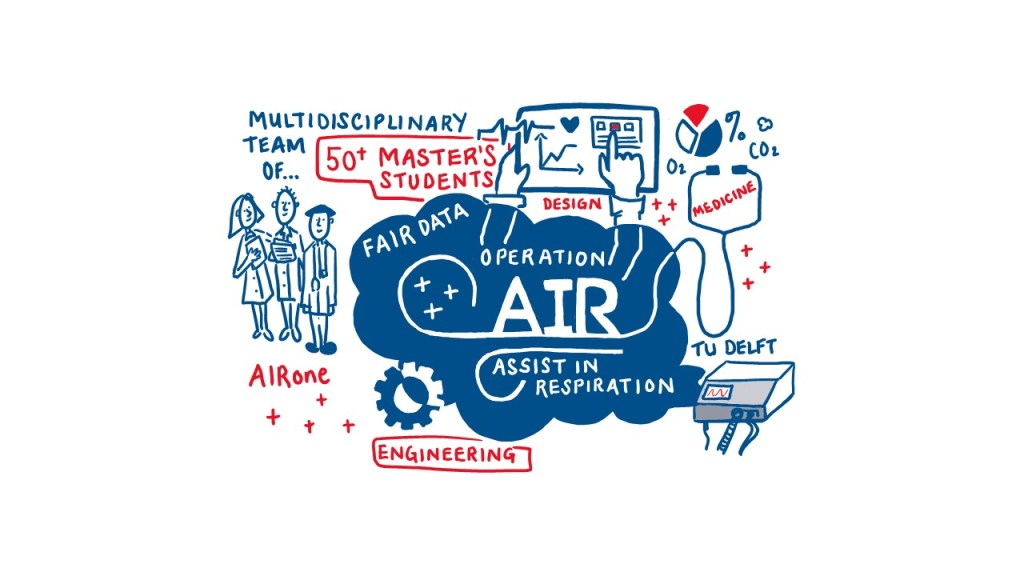
This troubling question inspired Professor Jaap Harlaar from the department of BioMechanical Engineering to kickstart OperationAIR (Assist In Respiration), a project that brought more than fifty TU Delft Master’s students together to produce emergency ventilators to cope with the shortage.
A race against time
Technical Medicine Master’s students, Tom Dijkhuis and Max Ligtenberg, helped to coordinate the multidisciplinary team of students from medical, engineering and design disciplines.

“When the pandemic first hit we were about to begin our clinical internships as part of our degree programme,” says Tom. “But, as the world prepared to tackle the pandemic, we had to adapt to the rapidly evolving situation and joined forces as OperationAIR instead.”
Tom describes OperationAIR as ‘a race against time’ as the team worked around the clock to design ‘AIRone’, a ventilator that is quick and cost-effective to manufacture, easy-to-use and safe to care for Covid-19 patients.


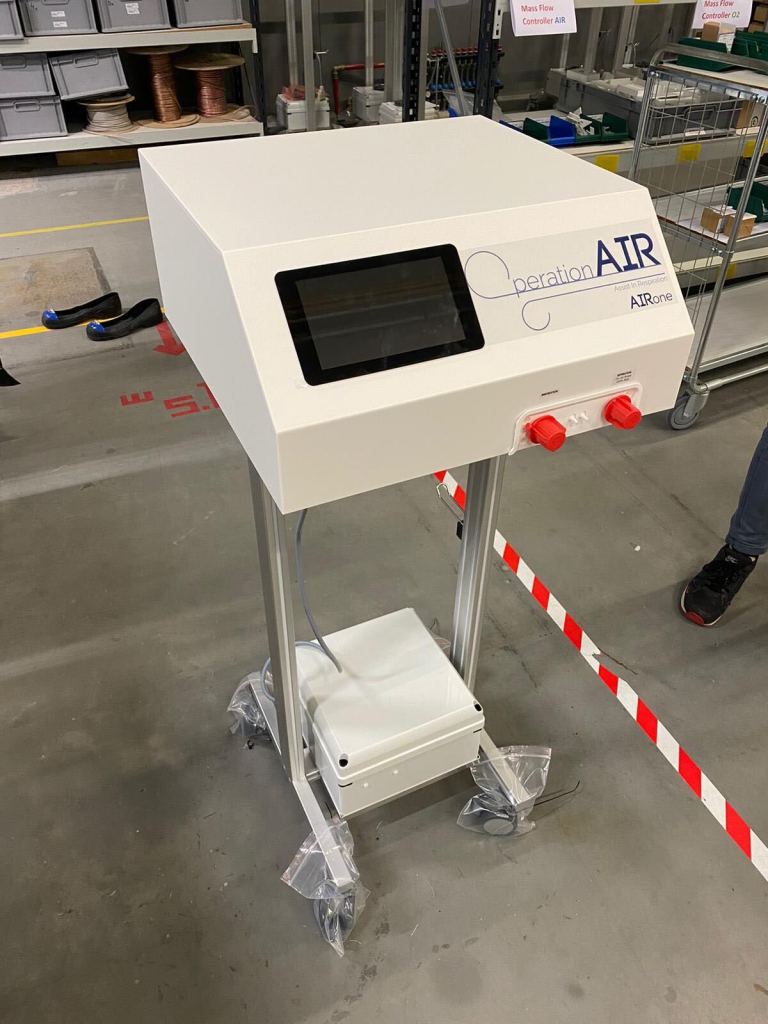
“It was a tense period of time and the team encountered many challenges. The global shortage of ventilator parts meant that our technical specification had to be adapted according to the availability of parts in the Netherlands.” He continues, “Stress was a positive driving force that led to the manufacture of 80 AIRone ventilators in three months. It was an amazing achievement.”
The OperationAIR team was divided into working groups responsible for different tasks to maximise productivity. Groups were assigned to project management; design and manufacturing; liaison with hospitals and health authorities; and, provision of training about how to use the ventilator.

Max adds that collaboration was the key to success. “The design specifications were drawn up together with medical professionals from the Leiden University Medical Center and the Erasmus Medical Center. We received support from a variety of organisations, including local 3D printers, NS railway operators, large multinational organisations and the Dutch Ministry of Health. The willingness to share information was truly overwhelming. Every door was open.”


Pay it forward by publishing data
The AIRone ventilator was primarily designed to care for Covid-19 patients in the Netherlands but it has value around the world.
After achieving their primary goal and designing AIRone, the next step was to ‘pay it forward’ by making their data openly available to benefit others. Tom and Max applied for the 4TU.ResearchData Data Refinement Fund to prepare their data for publication online.
“Publishing our data means that anyone around the world can learn from our experience and adapt our design specifications to meet the needs of patients in their own country. This saves time and effort, and enables fast-track medical innovation,” explains Max.
The published dataset comprises information about the AIRone hardware design which includes the 3D assembly model, technical drawings, a list of materials, design specifications, design verification and the technical manual. It also includes information about the software design, such as electronic designs for the printed circuit board, accompanying firmware (software code) and human interface (Open source documentation).

The Data Refinement Fund was used to employ Electrical Engineering Mathematics and Computer Science PhD student, Suryansh Sharma. As a member of the Delft Open Hardware team, Suryansh has valuable experience in making hardware designs open source and was, therefore, able to assist with making the OperationAIR data FAIR.
The data refinement process began with the consolidation of the various software, hardware, designs and manuals that were stored in GitHub and OSF. This required a considerable amount of time and effort as Suryansh had to evaluate numerous data files, selecting those of relevance for refinement.
As most of the data files were stored in PDF format, the data was not universally accessible or machine-readable. Therefore, Suryansh had to manually convert each PDF to markdown; a simple, lightweight text-based language that can be easily formatted and displayed in any text editor. He also ensured that each data file was well-documented so that they could be understood and reused by others.
The synergy between Suryansh and the student team made OperationAIR refinement possible.
“The OperationAIR student team did not have the time or expertise to conduct this work,” explains Tom. “The funds gave us an opportunity to employ Suryansh, who is an expert in open source, to help us curate our data more quickly and to a higher standard than would have otherwise been possible.”
Almost a year since its inception, Max reflects on his personal experience of working as a member of OperationAIR. “I’m so proud of what we achieved in a short space of time. This was a difficult few months but we showed what can be done when multidisciplinary teams unite to solve a global crisis.”
Fortunately, the need for ventilators was not as high as expected so AIRone was not deployed in a clinical setting. We thank Tom and Max for sharing their personal stories and wish the OperationAIR student team the best of luck in their future endeavours!
Dataset: https://doi.org/10.4121/14221724.v1
Written by Connie Clare (4TU.ResearchData)
Cover image illustrated by Connie Clare (4TU.ResearchData)