


Authors: Irina Motoc, Dorien Huijser, Leila Iñigo de la Cruz, Nida van Leersum
Introduction
A core part of our work at 4TU.ResearchData is focused on strengthening the digital skills and capacity of researchers and data professionals, which supports them in making data and software FAIR. While our repository primarily serves the Natural and Engineering Sciences (NES), our digital skills initiatives extend beyond this domain. By strengthening skills across institutes, we help to create a broader and more resilient foundation for research data management and open science.
We address skills and capacity gaps through three complementary perspectives: building digital capacity, training and curriculum development for data professionals, and sustainable research data and software training. These perspectives target researchers, data professionals, and trainers within our partner institutions and across the wider research community. Together, they strengthen both the expertise and the long‑term infrastructure needed for institutes to grow and sustain their own digital skills capacity.

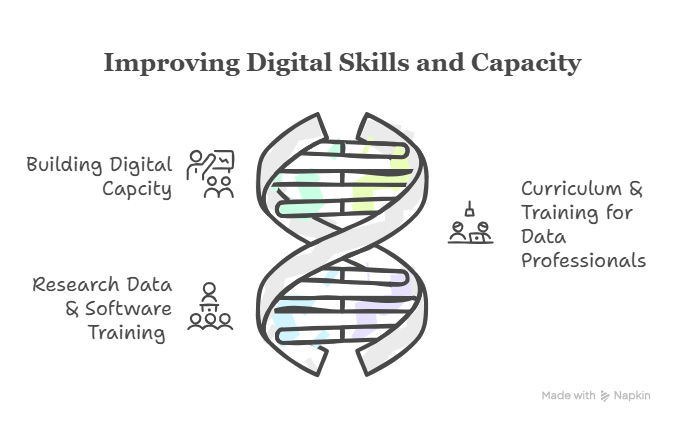
Our Three Perspectives on Skills
1. Building Digital Capacity
4TU.ResearchData leads a project on “Building digital skills training and lesson development capacity in the Netherlands NES domain” (DC4NES) to expand national capacity for computational and data skills training across the Natural and Engineering Sciences in the Netherlands. As researchers increasingly rely on programming, data management and reproducible workflows, DC4NES addresses the shortage of qualified trainers to meet this demand across Dutch research institutions, by preparing research support staff and researchers to become certified Carpentries instructors. The project will also develop openly licensed, NES‑specific lesson materials in fields such as chemistry, physics or geospatial science, ensuring alignment with current research practices.
To ensure sustainable growth, DC4NES will develop regional training ecosystems through Local Training Hubs where institutions share instructors, rotate workshop hosting, and reduce organisational overhead. This aims to create a stable, recurring training infrastructure that continues beyond the project and benefits students, PhDs, postdocs, and other researchers. To learn more, visit the Digital Capacity for NES project page on our website.
“Teaching is sharing, and sharing is at the core of Open Science. I will follow the Carpentry training because I want to champion Open Science.” — Nami Sunami, Data Steward, TU/e
2. Curriculum and Training for Data Professionals
Research Data Netherlands (RDNL), with 4TU.ResearchData as one of its four core partners, is developing a national training and community platform for research data professionals, funded by Open Science NL. Through this project, we are not only training data professionals in the RDNL courses “Essentials 4 Data Support” and “GDPR 4 Data Support”, but also contributing to a national platform that will meet training needs for the long term. This training platform will provide a national curriculum and a central place for data professionals to connect with relevant communities. As part of this effort, RDNL recently released an initial version of the national curriculum. This curriculum acts as a foundation for building a full national training programme over the next three years, including offerings from RDNL, external training providers, and new courses such as an RDNL Train‑the‑Trainer. As a way of certification, learners will be able to earn digital badges to demonstrate their acquired knowledge and skills, supporting flexibility and lifelong learning throughout the curriculum. To learn more, visit Research Data Netherlands.
“As a Data Steward, it is essential to have and update a knowledge base on managing research data. The courses stood out for creating new connections across many academic organisations, where interdisciplinarity and exchanging solutions to shared challenges is very valuable.” — Matthijs Netten, Data Steward TU Delft
3. Research Data and Software Training


4TU.ResearchData works with our partner institutions to build a sustainable training ecosystem that strengthens data and software literacy across the Natural and Engineering Sciences (NES). This year we continue to focus on embedding foundational reproducible research skills into institutional training, develop NES domain-specific workshops, and connect researchers with 4TU.ResearchData repository services such as the API, OPeNDAP server, and IIIF. Recent work has included delivering API‑focused workshops, piloting a lesson on Interoperability in Climate and Atmospheric Sciences, and supporting software‑skills training at TU Eindhoven and Wageningen University & Research.
To ensure long‑term impact, we aim to establish institute‑embedded workshops supported by a scalable training cycle. Domain‑specific materials, such as API workshops built around real use cases, reflect this approach. In our most recent API workshop, participants emphasised the value of these sessions, noting their motivation to attend:
“Visualizing the datasets published by our institutions and exploring potential data reuse published at my institute” - Minsi Li, Data Steward, University of Twente
“Getting theoretical and practical skills to deploy an app that monitors data and code resources” — Nestor de la Paz Ruiz, Software Steward, University of Twente.
To learn more, visit the training section of our website.
Conclusion
Our three perspectives on skills show that we reach a wide range of audiences and domains. We also recognise that sustainable skills and capacity development require good, long‑term structures, which we actively help to build together with our partner institutions and in collaboration with other organisations and initiatives such as the Netherlands eScience Center, DANS, SURF, Health-RI, TDCC-NES and Open Science NL. This spotlight summarises recent progress and we look forward to expanding and strengthening our skills development efforts in the years to come.